
The Benefits and Limits of At-Home Facial Massage!
Facial massage has moved from spa treatment rooms into everyday bathrooms and living rooms. Social media is full of jade rollers, gua sha stones, and "face yoga" routines promising everything from sculpted cheekbones to erased wrinkles. For many people, it is also a soothing ritual that fits naturally into a broader self-care or spa-at-home routine. Yet between genuine benefits, clever marketing, and unrealistic claims, it can be hard to know what at-home facial massage can really do-and where its limits lie.
This article looks at what the evidence actually supports, how facial massage interacts with skin and facial muscles, which tools and techniques matter, and when a professional treatment may still be the better choice. It also explores how to integrate facial massage into a wider routine that includes skincare, relaxation, and overall wellness.
What facial massage actually does to your skin and face
From a physiological standpoint, facial massage is a set of manual techniques-using fingers, knuckles, or tools-to apply controlled pressure, stretching, and movement to the skin and underlying tissues. The main short-term effects are relatively well understood: increased local blood flow, stimulation of lymphatic drainage, and activation of the nervous system pathways associated with relaxation.
Small studies, including research discussed by the American Academy of Dermatology and other dermatology sources, suggest that massage can temporarily increase circulation in the treated area, which may give the skin a slightly brighter, more "awake" appearance. By encouraging lymphatic flow, gentle, directional strokes can help reduce mild, fluid-related puffiness, particularly around the eyes and jawline. There is also evidence from broader massage research, summarized by organizations such as the National Institutes of Health (https://www.nih.gov/) and Mayo Clinic (https://www.mayoclinic.org/), that massage can lower perceived stress and muscle tension, which many people feel as jaw clenching, furrowed brows, or tight neck muscles.
However, facial massage does not fundamentally restructure bone, melt fat, or permanently "lift" skin. The face may look subtly more defined after a session because of reduced fluid retention and relaxed muscles, but these effects are transient. Collagen and elastin-the proteins that determine firmness and elasticity-are influenced more by genetics, sun exposure, lifestyle, and medical-grade treatments than by manual massage alone. Understanding this distinction helps set realistic expectations and allows people to appreciate facial massage for what it does well, rather than expecting it to replace more intensive procedures.
Proven benefits: from glow and relaxation to routine support
For many people, the most noticeable benefit of at-home facial massage is improved skin radiance. Increased superficial blood flow can give a gentle flush and make the complexion appear less dull, especially in colder climates or after long periods indoors. When massage is paired with a suitable facial oil or serum, it can also help products spread evenly and may enhance short-term absorption by warming the skin and slightly increasing permeability. This is particularly relevant for those following consistent routines focused on hydration, barrier repair, and targeted actives, which are common themes across skincare and beauty coverage.
Another significant benefit is relaxation. The face, scalp, and neck are rich in nerve endings and muscles that respond strongly to stress. At-home massage around the jaw, temples, and brow can ease tension from clenching, screen use, and everyday strain. Some people integrate facial massage into a broader wellness or evening wind-down ritual, alongside breathing exercises, gentle stretching, or yoga practices. This mind-body dimension is supported by wider research on massage and stress, including summaries from the Cleveland Clinic (https://my.clevelandclinic.org/) and Harvard Health Publishing (https://www.health.harvard.edu/), which highlight reductions in anxiety and perceived pain in various contexts.
Facial massage can also support awareness of facial habits. By routinely touching and observing their own faces, people often become more conscious of repetitive expressions, such as frowning at screens or lifting the brows unnecessarily. This awareness can encourage subtle behavioral changes that may, over time, reduce the deepening of some expression lines. While this is not the same as erasing wrinkles, it is a realistic way in which massage intersects with long-term skin appearance. Finally, carving out even five minutes for a massage ritual can reinforce a sense of self-care, which many readers integrate with broader lifestyle changes around sleep, nutrition, and stress management.
The limits: what at-home facial massage cannot do
Despite its benefits, at-home facial massage has clear limits that are important to recognize. First, it cannot permanently tighten significantly lax skin or reverse advanced signs of photoaging. Loss of elasticity, deep folds, and marked sagging are primarily structural issues involving collagen, elastin, and fat distribution. Treatments with stronger evidence for meaningful change in these areas-such as prescription retinoids, energy-based devices, or injectables-are medical or aesthetic procedures that should be discussed with qualified dermatologists or plastic surgeons. Organizations like the American Academy of Dermatology (https://www.aad.org/) and British Association of Dermatologists (https://www.bad.org.uk/) provide overviews of such options and their evidence.
Second, massage cannot safely dissolve fat or "reshape" bone. Claims that gua sha or vigorous kneading can permanently slim the face are not supported by robust clinical evidence. Any visible "slimming" after a single session is far more likely to be reduced swelling or fluid retention. Long-term changes in facial fullness are more strongly driven by body weight, aging, genetics, and, in some cases, medical conditions. Similarly, bone structure is fixed in adults; tools cannot sharpen the jaw in a literal skeletal sense, despite how lighting, makeup, and temporary de-puffing can create that impression in photographs.
Third, facial massage is not a cure for medical skin conditions such as severe acne, rosacea, or eczema. In some cases, especially with aggressive techniques or unsuitable oils, massage can actually worsen redness, sensitivity, or breakouts. Dermatology guidance from bodies like the American Academy of Dermatology and National Health Service in the UK (https://www.nhs.uk/) consistently emphasizes that inflammatory skin diseases require tailored treatment, not just mechanical manipulation. Finally, massage is not a substitute for core health behaviors: sun protection, balanced nutrition, adequate sleep, and regular movement have far more impact on long-term skin health and overall wellbeing than any single beauty ritual.
Tools and techniques: hands, rollers, and gua sha
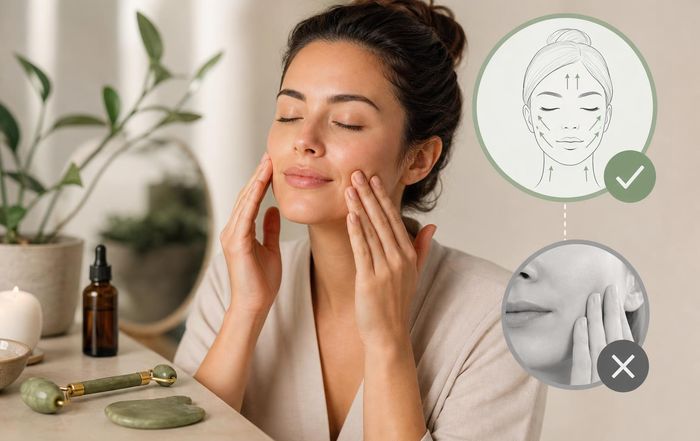
At-home facial massage can be done entirely with clean hands, and many professionals argue this remains the most versatile and intuitive approach. Fingers allow nuanced control of pressure, direction, and feedback from the skin. Classic techniques include effleurage (long, gliding strokes), petrissage (gentle kneading), and light tapping or "piano" movements to stimulate the surface. Working from the center of the face outward and upward is common, with strokes directed toward lymph nodes around the ears and down the sides of the neck to support drainage.
Tools such as jade rollers and gua sha stones have become highly visible, in part because they photograph well and are easy to market. A cool roller can feel soothing, especially around puffy eyes, and may temporarily constrict superficial blood vessels, which can reduce redness and swelling for a short period. Gua sha, adapted from traditional East Asian techniques, uses flat stones (often jade or quartz) to apply gentle scraping motions along muscles and lymphatic pathways. When used lightly with a facial oil, it can help release tension in the jaw and neck and encourage fluid movement. Traditional Chinese medicine resources, including those discussed by institutions such as Johns Hopkins Medicine (https://www.hopkinsmedicine.org/), note that gua sha has long been used on the body, though facial adaptations are generally far gentler.
However, no credible evidence shows that one stone type is inherently superior to another, despite marketing claims about crystal "energy." The main functional differences relate to shape, smoothness, and temperature retention. What matters more is technique: always using a slip product (like a non-comedogenic oil), keeping pressure light to moderate, and avoiding dragging or folding the skin. For those interested in a more spa-like experience, combining a short massage with other spa and salon-style rituals-such as a warm compress or a gentle mask-can enhance the sensory aspect without needing complex equipment.
Safety, skin types, and when to be cautious
Most healthy individuals can safely perform gentle facial massage, but certain skin types and conditions require extra care. People with active inflammatory acne should avoid heavy pressure, prolonged friction, or occlusive oils that may clog pores. Spot-treating around, rather than over, inflamed lesions is usually safer, and non-comedogenic products are essential. Those with rosacea, highly sensitive skin, or a compromised barrier (for example, from over-exfoliation or retinoid irritation) should keep techniques extremely gentle and limit session length, as mechanical stimulation can trigger flushing or burning. When in doubt, dermatology associations such as the American Academy of Dermatology and public-health resources like the World Health Organization (https://www.who.int/) emphasize the value of seeking professional advice before introducing new practices to already stressed skin.
Individuals with certain medical conditions-such as clotting disorders, recent facial surgery, fillers or thread lifts, severe eczema, or uncontrolled autoimmune disease-should speak with their healthcare provider before starting any vigorous massage routine. Similarly, people using prescription treatments like isotretinoin often have fragile, easily damaged skin and are typically advised to avoid aggressive manipulation. Pregnancy itself is not usually a barrier to facial massage, but anyone with pregnancy-related skin changes or concerns about melasma, blood pressure, or swelling should confirm safety with their clinician.
Hygiene also matters. Tools should be cleaned regularly with mild soap and water and dried thoroughly to reduce bacterial growth. Hands must be washed before touching the face, especially if massaging near the eyes or mouth. Overly frequent or intense massage can backfire, causing irritation, broken capillaries, or worsening of existing redness. A balanced approach-short, gentle sessions a few times per week-is generally safer than daily, forceful routines, particularly for those with reactive skin.
Integrating facial massage into a broader self-care routine
Facial massage tends to work best when it is one element of a broader self-care plan rather than a standalone fix. Many people weave it into their evening skincare, pairing it with cleansing balms, facial oils, or nourishing creams. Taking a few extra minutes to massage these products in can transform a basic routine into a more mindful ritual. Those who are already exploring health, wellness, and food and nutrition approaches to skin-from balanced diets rich in antioxidants to hydration and reduced ultra-processed food intake-may find that massage complements these efforts by supporting relaxation and consistency.
Some people combine facial massage with breathwork or short meditative practices, using the time to disconnect from screens and focus on bodily sensations. This can be especially helpful for individuals who carry stress in the jaw, neck, and scalp. Evidence from organizations like Mind in the UK (https://www.mind.org.uk/) and the American Psychological Association (https://www.apa.org/) underscores that small, regular stress-reduction practices can contribute to better mental wellbeing, and massage can serve as a tactile anchor for these moments.
For those interested in more structured routines, "face yoga" or facial exercises have gained popularity, with some small studies suggesting possible improvements in perceived fullness and youthfulness in specific age groups. However, the evidence base remains limited, and it is not clear which specific exercises are most effective. As with massage, consistency and gentle technique are more important than intensity. Integrating facial work with whole-body practices like yoga, stretching, or low-impact fitness can reinforce a holistic approach, where the goal is not perfection but feeling more comfortable and relaxed in one's body.
When to seek professional treatments instead
While at-home facial massage is accessible and low-cost, there are times when professional treatment may be more appropriate. Those with complex skin concerns-such as persistent cystic acne, significant pigmentation, or scarring-are likely to benefit more from an individualized plan created by a dermatologist or qualified aesthetic practitioner. Professional facials, especially when delivered by trained therapists in reputable spa and salon settings, can incorporate advanced techniques, sterile tools, and targeted actives in ways that are difficult to replicate safely at home.
Medical and cosmetic procedures, including chemical peels, microneedling, lasers, and injectables, have a far stronger evidence base for structural skin changes than massage alone. Organizations like the American Society for Dermatologic Surgery (https://www.asds.net/) and International Society of Aesthetic Plastic Surgery (https://www.isaps.org/) outline the indications, benefits, and risks of these options. For individuals considering such treatments, at-home massage may still play a role-helping maintain skin comfort, supporting relaxation, and reinforcing a sense of agency in day-to-day care-but it should not be seen as interchangeable with clinical interventions.
Professional guidance is also useful for people who are unsure how to adapt massage to their specific skin type or health context. A short consultation with a dermatologist, aesthetic nurse, or licensed esthetician can clarify what is safe, which products are suitable, and how to avoid interfering with existing treatments. In some cases, practitioners may teach customized at-home techniques that respect recent procedures or sensitivities, blending the best of professional and home care.
Making the most of an at-home facial massage ritual
Used thoughtfully, at-home facial massage is a gentle, low-risk way to support skin comfort, enhance product application, and create a small daily or weekly ritual of touch and relaxation. Its benefits are real but modest: a temporary glow, subtle de-puffing, tension relief, and a stronger connection to one's own face and expressions. Its limits are equally important: it will not remodel bone, dissolve fat, or reverse significant skin aging, and it can aggravate certain conditions if used too aggressively or without regard for individual sensitivities.
For those building a broader self-care lifestyle around rest, movement, nutrition, and mental wellbeing, facial massage can be a pleasant thread that ties various practices together. Approached with realistic expectations and informed by guidance from reputable health and dermatology sources, it becomes less about chasing dramatic transformations and more about cultivating a small, repeatable moment of calm in a busy day.
