
Breathing Exercises to Help You Unwind After Work
After a long day, the body may leave the office, but the nervous system often stays "on call." Shoulders stay tight, the jaw clenches, and thoughts loop through unfinished emails and to-dos. Intentional breathing is one of the simplest, fastest ways to interrupt this stress cycle. It directly influences the nervous system, nudging the body from a fight-or-flight state into a rest-and-digest mode that feels much closer to a spa visit than a commute. Unlike supplements or elaborate routines, breathwork is free, portable, and adaptable whether someone is stepping off a late train in London, closing a laptop in New York, or finishing a shift in Singapore.
Modern research supports what yoga and meditation traditions have taught for centuries. Slow, controlled breathing can reduce heart rate, lower blood pressure, and calm the stress response by shifting activity in the autonomic nervous system. Organizations such as the American Heart Association highlight that relaxation techniques, including breathing, may support cardiovascular health when combined with other lifestyle changes, while bodies like the National Center for Complementary and Integrative Health emphasize their role in stress management and emotional regulation. For people who want a realistic, after-work routine that fits into a busy life, breathwork can act as a bridge between the demands of the day and the rest of the evening.
In this guide, several evidence-informed breathing techniques are explored, along with how and when to use them, what the science suggests, and how to turn them into a sustainable ritual that feels as restorative as a brief home spa session. Readers who are also curious about complementary practices like yoga, meditation, or stretching may find it helpful to combine these exercises with ideas from dedicated resources on wellness, yoga, or fitness for a more rounded end-of-day routine.
How breathing changes the stress response
Breathing is one of the few bodily functions that is both automatic and under voluntary control. This makes it a powerful gateway into the autonomic nervous system, which regulates heart rate, digestion, blood vessel tone, and many other processes that respond to stress. When someone is anxious or rushing, the breath tends to become shallow and fast, often centered in the upper chest. This pattern is associated with sympathetic nervous system activation-the body's fight-or-flight mode. In contrast, slow, diaphragmatic breathing stimulates the vagus nerve and supports parasympathetic activity, which is associated with relaxation, better digestion, and a sense of safety.
Research summarized by institutions such as Harvard Medical School and Cleveland Clinic suggests that slow breathing, especially around six breaths per minute, can help synchronize heart rate and breathing in a way that improves heart rate variability (HRV), a marker often associated with resilience to stress. The World Health Organization and national public health agencies also recognize stress management as a component of broader health promotion, noting that chronic stress can contribute to sleep disturbances, digestive issues, mood changes, and unhealthy coping behaviors. Breathing exercises do not replace medical care or psychological therapy, but they can provide a practical self-regulation tool, especially in the window between work and home life when many people feel emotionally overloaded.
From a spa and self-care perspective, focusing on breath also acts as a mindfulness anchor. It draws attention away from screens and mental chatter, returning awareness to physical sensations-air moving in and out, the rise and fall of the belly, the feeling of the body on a chair or mat. This shift in attention can be as important as the physiological effects, helping to establish a daily ritual that signals, "Work is done; now it's time to rest." Combining breathwork with other calming habits-such as a warm shower, skincare routine, or herbal tea-can enhance this transition, as explored in lifestyle-oriented sections of health and lifestyle content.
Setting up a mini "after-work spa" for breathwork
While breathing practices can technically be done anywhere, a small amount of preparation can make them more effective and more enjoyable. Creating a consistent after-work environment trains the brain to associate certain cues with relaxation. This does not require candles or expensive equipment, although some people enjoy incorporating elements from spa culture-soft lighting, calming scents, or gentle music-to support the mood.
A good starting point is to choose a specific location: a favorite armchair, a spot on the sofa, a yoga mat on the floor, or even the driver's seat of a parked car before going inside. Aim for a posture that is both alert and comfortable. Sitting upright with the feet flat on the floor and the spine long is often ideal because it allows the diaphragm to move freely. Lying down can work well for some techniques, especially for people who experience dizziness when changing their breathing patterns, but it can also lead to drowsiness, which may or may not be desired before dinner or evening activities.
Reducing distractions helps the nervous system settle more quickly. Silencing notifications, lowering the brightness of screens, and letting household members know that a brief "transition time" is underway can all be valuable. For those who enjoy aromatherapy, a light scent of lavender, chamomile, or sandalwood-often discussed in spa and beauty settings-may enhance the sense of ritual, though fragrances are optional and should be avoided if they trigger headaches or allergies. Gentle background music, such as nature sounds or instrumental tracks, can also support relaxation, provided it does not distract from counting or feeling the breath.
Finally, it is worth setting an intention before beginning. This might be as simple as "I'm letting go of work," "I'm preparing for a calm evening," or "I'm giving my body five minutes of care." Intention-setting is a common element in yoga and mindfulness traditions, and organizations like Mindful and Headspace emphasize its role in helping people stay present during short practices. Even a single sentence can help frame breathing exercises as a meaningful act of self-care rather than another task on an endless list.
Diaphragmatic breathing: the foundation technique
Many after-work breathing exercises build on diaphragmatic, or "belly," breathing. The diaphragm is a dome-shaped muscle beneath the lungs that plays a central role in respiration. When it contracts, it moves downward, allowing the lungs to expand more fully. This often causes the belly to rise slightly, which is why the technique is sometimes called abdominal breathing. When breathing is shallow and chest-based, the diaphragm is underused, and accessory muscles in the neck and shoulders do more work, contributing to tension and fatigue.
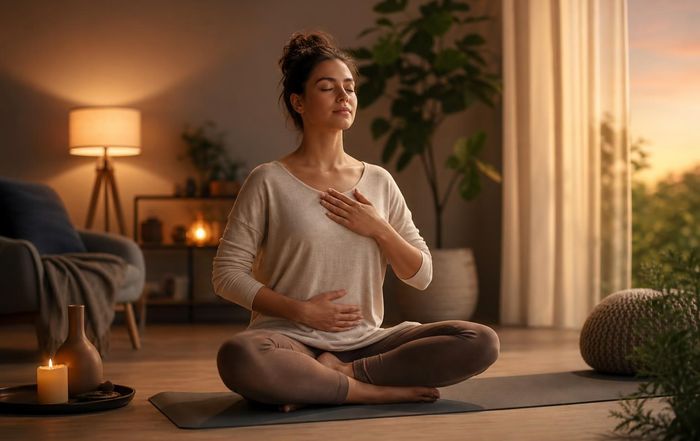
Health organizations such as Mayo Clinic and Johns Hopkins Medicine describe diaphragmatic breathing as a core relaxation technique that can help reduce stress and support more efficient breathing. To practice it after work, sit or lie comfortably and place one hand on the chest and one on the abdomen, just below the ribs. Gently inhale through the nose, aiming for the lower hand to rise while the upper hand stays relatively still. The breath should feel smooth rather than forced. Then exhale slowly through the nose or pursed lips, allowing the belly to fall. The focus is on the movement of the abdomen and the sensation of air flowing rather than on achieving a certain volume of breath.
For beginners, practicing this for three to five minutes is usually enough. It can be integrated into a broader end-of-day routine, perhaps following light stretching or a brief walk, topics often explored in fitness and wellness resources. People who spend much of the day hunched over a desk may find it helpful to gently roll the shoulders or open the chest before starting so that the ribcage can expand more easily. Over time, diaphragmatic breathing can become more natural, reducing the tendency toward shallow, upper-chest breathing even during the workday.
4-7-8 breathing for rapid unwinding
Among the many structured breathing patterns, the 4-7-8 technique has gained popularity as a simple, time-bound exercise that can quickly downshift the nervous system. Popularized by integrative medicine practitioners and discussed by institutions such as Arizona Center for Integrative Medicine, this method is loosely inspired by ancient pranayama practices. While formal clinical trials are still limited, many people find it subjectively calming, and its slow rhythm aligns with what researchers consider a relaxing breathing pace.
To practice 4-7-8 breathing after work, start by exhaling fully through the mouth, making a soft whooshing sound if comfortable. Then close the mouth and inhale quietly through the nose for a count of four. Hold the breath gently for a count of seven-without straining or clenching the throat-and then exhale through the mouth for a count of eight, again with a soft whooshing sound. This completes one cycle. Beginners are often advised to start with four cycles, which takes less than two minutes, and gradually increase to eight cycles as the pattern becomes more familiar.
The lengthened exhale is particularly important. A longer out-breath is associated with increased parasympathetic activity, which can promote relaxation and a sense of release. For people who tend to ruminate about work in the evening, counting provides a cognitive anchor that competes with repetitive thoughts. It can be helpful to pair the exhale with a mental phrase such as "letting go" or "done for today." For those who enjoy structured routines, this technique can be a fixed part of an evening ritual that might also include light yoga, a nourishing meal inspired by food and nutrition guidance, or a skincare routine.
Box breathing: a steady pattern for mental clarity
Box breathing, sometimes called square breathing, uses equal lengths for inhaling, holding, exhaling, and holding again. It has been used in contexts ranging from mindfulness training to performance psychology, and it is sometimes discussed in relation to high-stress professions where focus and calm are crucial. Organizations like UCLA Health and Cleveland Clinic describe box breathing as a way to balance the nervous system and settle racing thoughts, making it a useful tool for transitioning out of a cognitively demanding workday.
To practice box breathing, sit comfortably with the spine upright. Inhale through the nose for a count of four, feeling the belly and ribcage expand. Gently hold the breath for a count of four, keeping the shoulders relaxed. Exhale through the nose for a count of four, allowing the body to soften. Then pause again with empty lungs for a count of four before starting the next cycle. Those who are more comfortable with slower breathing can extend the count to five or six, but it is usually best to begin with four-count segments and adjust gradually, especially if there is any history of respiratory issues.
Visualizing a square can help maintain rhythm. Some people imagine tracing one side of a box with each phase of the breath, while others find it helpful to use a finger or gaze to follow the corners of a physical object. Because the pattern is regular and predictable, it can be especially useful for people who feel mentally scattered after work, juggling emails, family responsibilities, and social commitments. A few minutes of box breathing before checking messages or switching into evening tasks can create a small but meaningful sense of order and control. It can also be combined with gentle movement or restorative yoga poses, themes often explored in yoga and wellness content.
Extended exhale breathing: lengthening the "letting go"
Many relaxation practices emphasize the exhale. When exhaling, the heart rate naturally slows, and the body tends to move toward parasympathetic dominance. Techniques that deliberately lengthen the out-breath can therefore be particularly effective for unwinding after stress. Extended exhale breathing is less structured than 4-7-8 or box breathing, making it suitable for people who dislike counting but still want a clear method.
A simple approach is to inhale gently through the nose for a comfortable count-often three or four-and then exhale for roughly twice as long, perhaps six to eight counts. The exact numbers are less important than the ratio; the exhale should be noticeably longer without feeling forced. It can help to imagine sighing out tension from the shoulders, neck, and jaw with each breath. For those who carry work stress in their posture, pairing extended exhale breathing with small movements-such as rolling the shoulders or gently turning the head side to side-can enhance the sense of release.
Public health and mental health organizations, including NHS in the United Kingdom and National Institute of Mental Health in the United States, often recommend slow exhalation as part of breathing strategies for anxiety and stress. Extended exhale breathing is particularly useful in moments of acute tension, such as after a difficult meeting or commute. It can be done discreetly at a desk, in a restroom, or while waiting for public transport, making it a versatile tool throughout the day, not only at home. When practiced regularly, it may help reduce the intensity of the "crash" many people feel when they finally stop working.
Alternate nostril breathing: balancing and centering
Alternate nostril breathing, known as nadi shodhana or anulom vilom in yoga traditions, is often described as a balancing practice. While scientific research is still emerging, some studies suggest that it may influence autonomic function and support a sense of calm alertness. Organizations such as Yoga Alliance and integrative medicine centers highlight it as a traditional technique used to harmonize energy and focus the mind, making it a thoughtful choice for those who enjoy a more meditative, ritualistic approach to after-work unwinding.
To practice a gentle form of alternate nostril breathing, sit comfortably with an upright spine. Using the right hand, lightly rest the index and middle fingers between the eyebrows, with the thumb near the right nostril and the ring finger near the left nostril. Close the right nostril with the thumb and inhale slowly through the left nostril. Then close the left nostril with the ring finger, release the right nostril, and exhale through the right side. Next, inhale through the right nostril, then close it with the thumb, release the left nostril, and exhale through the left. This completes one cycle. Breathing should remain smooth and comfortable, without forceful inhalation or exhalation.
A few minutes of alternate nostril breathing can be particularly helpful for people who feel mentally fragmented after multitasking all day. The deliberate hand movements and focus on airflow through each nostril require gentle concentration, drawing attention away from work-related worries. Because the technique involves partially restricting airflow, it is not suitable for everyone-those with nasal congestion, recent sinus surgery, or respiratory conditions should consult a healthcare professional first. For many, however, it can become a cherished evening ritual that pairs well with other calming practices like gentle stretching, journaling, or listening to soothing music, themes often woven through lifestyle and spa and salon content.
Pairing breathwork with movement, spa rituals, and daily habits
Breathing exercises are powerful on their own, but they can be even more effective when integrated into a broader self-care framework. Simple movements, such as neck stretches, shoulder rolls, or cat-cow motions on a yoga mat, can help release muscular tension that has built up during the workday, particularly for those who sit for long periods. Coordinating these movements with the breath-for example, inhaling while opening the chest and exhaling while rounding the spine-can create a flowing sequence that feels both grounding and energizing. Yoga organizations like Yoga Journal and health systems such as Kaiser Permanente often recommend combining breath with gentle movement to support joint mobility and relaxation.
Spa-inspired rituals can also enhance breathwork. A warm shower or bath before or after breathing exercises can help loosen muscles and signal the end of the workday. Some people enjoy using essential oils in a diffuser, though it is important to choose reputable sources and dilute oils properly, as recommended by bodies such as Aromatherapy Trade Council and NIH. Skincare or body-care routines, often featured in beauty and spa and salon discussions, can be turned into mindful practices by synchronizing motions-such as massaging moisturizer into the hands or face-with slow, steady breathing.
Daily habits around nutrition, movement, and sleep also influence how easily the body unwinds after work. Heavy caffeine intake late in the day, irregular meals, or long periods of inactivity can amplify evening restlessness. Guidance from organizations like the World Health Organization, American Psychological Association, and national dietary advisory bodies suggests that balanced eating, regular physical activity, and consistent sleep schedules all support stress resilience. While breathing exercises can help in the moment, they are most effective when layered on top of a generally supportive lifestyle. Readers interested in a more holistic approach may find it useful to explore resources on health, food and nutrition, and wellness to complement their breathwork practice.
Safety, limits, and when to seek professional support
Breathing exercises are generally considered low-risk for healthy adults, but they are not entirely without precautions. People with chronic respiratory conditions such as asthma, COPD, or severe allergies should consult a healthcare professional before significantly changing their breathing patterns, particularly for techniques that involve breath-holding. Organizations like American Lung Association and Asthma + Lung UK emphasize that while breathing training can be beneficial, it should be tailored to individual medical needs. If any exercise causes dizziness, chest pain, intense shortness of breath, or panic, it should be stopped immediately, and medical advice should be sought.
Those with a history of panic attacks or certain anxiety disorders may find that focusing on breath initially increases awareness of bodily sensations, which can feel uncomfortable. Mental health organizations such as National Alliance on Mental Illness and Mental Health Foundation recommend introducing such practices gradually and, where possible, under the guidance of a therapist or qualified instructor. If breathing exercises consistently trigger distressing feelings rather than relief, it may indicate that a different approach-such as cognitive behavioral therapy, counseling, or group support-is more appropriate as a primary strategy, with breathwork playing a supporting role.
It is also important to keep expectations realistic. Breathing exercises can be powerful tools for acute stress and can contribute to long-term resilience when practiced regularly, but they do not erase structural issues such as overwork, workplace harassment, or financial strain. In some cases, unwinding after work may require broader changes in boundaries, workload, or career direction, topics that intersect with careers, business, and lifestyle discussions. Recognizing the limits of self-care can prevent people from blaming themselves when stress persists despite their best efforts.
Finally, it is worth remembering that consistency matters more than perfection. A few minutes of simple diaphragmatic or extended exhale breathing most days will usually offer more benefit than an elaborate routine attempted once a week. Choosing one or two techniques that feel natural, integrating them into daily life, and adjusting them as circumstances change can transform the transition from work to home into a small but meaningful daily ritual of care.
By approaching breathing exercises as part of an overall after-work ritual-supported by movement, mindful habits, and realistic boundaries-anyone can create a brief, spa-like pause between the demands of the day and the rest of life. Whether practiced in a quiet corner of a shared apartment, on a balcony overlooking a busy city, or in a calm living room at the end of a remote-work day, the simple act of breathing with intention can become a reliable way to unwind, reset, and reconnect with the body before the evening begins.
