
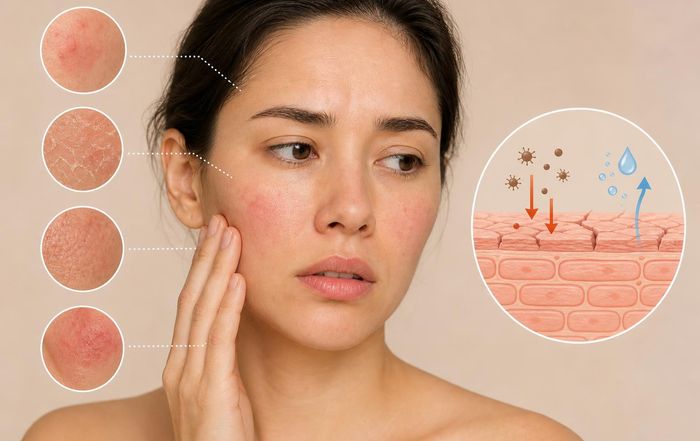
How to Recognize (and Calm) a Damaged Skin Barrier
When skin suddenly becomes tight, stingy, or reactive to products that used to feel fine, the underlying issue is often not "sensitive skin" but a disrupted skin barrier. For anyone who loves facials, at-home peels, or active ingredients, understanding the signs of barrier damage is one of the most important steps in long-term skin health and a calmer spa-style routine at home. How to explain what the skin barrier actually is, how to recognize when it is struggling, what commonly causes the damage, and how to gently repair it without guesswork?
What the Skin Barrier Actually Is
The "skin barrier" usually refers to the outermost layer of the skin, the stratum corneum, which works a bit like a brick wall. The "bricks" are dead skin cells (corneocytes), and the "mortar" is a mixture of lipids such as ceramides, cholesterol, and fatty acids. Together, they help keep water in and irritants, pollutants, and microbes out.
Dermatology and skin biology research, including work summarized by the American Academy of Dermatology (AAD), has shown that a healthy barrier:
Minimizes water loss (transepidermal water loss, or TEWL).
Maintains a slightly acidic surface (the "acid mantle").
Hosts a balanced microbiome of bacteria and other microorganisms.
Buffers the skin from environmental and chemical irritants.
When that structure is disrupted-by over-exfoliation, harsh cleansers, UV radiation, or medical skin conditions-the result is often dehydration, inflammation, and increased sensitivity. Many common concerns that send people to spas and dermatology clinics-dullness, roughness, redness, and even breakouts-are closely tied to barrier function.
Key Signs Your Skin Barrier May Be Damaged
Because many skin issues can look similar, it helps to think in clusters of signs and sensations rather than relying on a single symptom. Persistent or severe changes should always be evaluated by a health professional, but several patterns strongly suggest barrier compromise.
1. Sudden, Unusual Sensitivity and Stinging
One of the clearest clues is when products that previously felt comfortable suddenly sting, burn, or itch upon application. This is especially telling if it happens with very basic products such as fragrance-free cleansers or moisturizers. A disrupted barrier allows irritants and even normal ingredients to penetrate more deeply, triggering nerve endings and inflammation. Sensitive, stinging skin is a common complaint in dermatology clinics, and studies summarized by organizations like the National Eczema Association (NEA) highlight impaired barrier function as a core factor in many sensitive-skin conditions.
If you notice a burning sensation with water, cleansers, or sunscreens that used to feel fine, or if you suddenly cannot tolerate mild acids or retinoids you previously used without trouble, that pattern is highly suggestive of barrier stress.
2. Tightness, Dryness, and Dehydration
Another hallmark is a feeling of tightness, especially after cleansing or showering. The skin may feel as if it is one size too small, even if it does not look obviously flaky. This tight, "paper-like" sensation often reflects increased transepidermal water loss because the lipid "mortar" is compromised.
Dehydrated skin may appear dull, with fine, crêpe-like lines that look more pronounced when you smile or move your face. Unlike chronically dry skin (which is more about oil production), dehydration is about water content and can affect any skin type, including oily or acne-prone skin. Hydration science from groups like the International Society of Dermatology and resources from DermNet (DermNet) emphasize that barrier lipids are essential to slowing water evaporation; when they are stripped away, even heavy creams may seem to "sit on top" without relieving the tightness.
3. Redness, Burning, and Inflammation
Redness that appears easily and lingers-particularly after cleansing, exfoliating, or exposure to heat, wind, or sun-is another common sign. This can range from diffuse pinkness to more visible red patches and can be accompanied by warmth, burning, or tingling.
In some people, especially those predisposed to rosacea or eczema, barrier disruption can trigger flare-ups with pronounced redness and visible blood vessels. While only a clinician can diagnose these conditions, resources from the National Rosacea Society (NRS) and NEA consistently link barrier care and gentle routines with better symptom control. If your face flushes intensely with minor triggers (a warm room, a gentle scrub, or a glass of wine) and remains red for a long time, your barrier may be struggling.
4. Flaking, Peeling, and Rough Texture
Visible flaking, peeling, or a rough, sandpapery texture often follows a period of aggressive exfoliation, high-strength retinoids, or chemical peels. While some controlled peeling is expected during certain treatments, widespread or prolonged flaking in everyday life typically indicates that the outer skin layers are being shed faster than they can be properly replenished.
This can show up as makeup catching on dry patches, foundation looking patchy around the nose and mouth, or a general loss of that smooth, light-reflective surface people associate with "glow." Harvard Health Publishing (Harvard Health) notes that over-stripping the outer layer disrupts not only lipids but also the natural cell-turnover rhythm, leading to uneven texture and a compromised protective barrier.
5. Breakouts with an Irritated, "Angry" Feel
Barrier damage can paradoxically make acne-prone skin worse. When the barrier is compromised, the skin may respond with both dryness and increased oil production, while being more vulnerable to bacteria and inflammation. The result can be breakouts that feel sore, look red and inflamed, and coexist with flaky, peeling areas.
This combination-pimples plus stinging, plus dryness-is often misinterpreted as "my acne is so bad I need stronger products," which can lead to even harsher treatments and further barrier damage. Dermatology guidance from groups like the American Academy of Dermatology stresses that acne regimens should be paired with barrier-supportive moisturizers and sunscreens, especially when using retinoids or benzoyl peroxide.
6. Itching and a Crawling Sensation
Mild to moderate itching without an obvious rash, or a sensation of "crawling" or discomfort on the skin's surface, can signal that the barrier is not keeping irritants out as effectively. This is particularly common on the body after hot showers, in dry climates, or in people with eczema-prone skin. The World Health Organization (WHO) and national health agencies highlight the role of barrier-repair emollients in managing chronic itch conditions, underscoring the link between barrier integrity and sensory comfort.
Persistent or severe itch, especially if it interferes with sleep or is accompanied by widespread rash, should be assessed by a healthcare provider to rule out eczema, allergies, infections, or systemic conditions.
7. Delayed Healing and Marking from Minor Irritation
Finally, damaged barrier skin often recovers more slowly from everyday insults. A minor scratch, a bit of friction from a mask or clothing, or a popped pimple may leave redness, dark marks, or textural changes that linger longer than they used to. Skin may bruise or mark more easily, and post-inflammatory hyperpigmentation can become more common.
Researchers in skin aging and wound healing, including teams referenced by the National Institutes of Health (NIH), have shown that barrier lipids and the microbiome are involved in the early phases of repair. When that first line of defense is weakened, the healing cascade is slower and more easily derailed by infection or inflammation.
Common Causes of Skin Barrier Damage
Recognizing the signs is only half the story; the other half is identifying what might be driving the problem so changes can be made. For many people, barrier damage is not caused by a single dramatic event but by several small, repeated habits.
Over-Cleansing and Harsh Surfactants
One of the most frequent culprits is cleansing too often or with formulas that are too stripping. Traditional high-pH soaps and some foaming cleansers remove not only dirt and makeup but also the skin's natural lipids and disrupt the acid mantle. When used multiple times a day, especially with hot water, they can significantly increase water loss.
Dermatology organizations and cosmetic chemists increasingly recommend pH-balanced, sulfate-free cleansers for most face routines. For spa lovers who double-cleanse, it is especially important to ensure both steps are gentle and to avoid unnecessary scrubbing, particularly around delicate areas such as the eyes.
Excessive or Aggressive Exfoliation
Chemical exfoliants (AHAs, BHAs, PHAs), physical scrubs, microdermabrasion devices, and even cleansing brushes can all be safe when used appropriately. Problems arise when multiple exfoliating products are layered, used too frequently, or combined with other potent actives like retinoids without adequate recovery time.
The British Association of Dermatologists (BAD) and similar bodies warn that disrupted stratum corneum from over-exfoliation can lead to sensitivity, post-inflammatory pigmentation, and flare-ups of existing skin conditions. At home, a useful rule of thumb is that if skin is stinging, peeling, or persistently red, exfoliation should be paused until the barrier is calm again.
Strong Actives and DIY "Cocktails"
Retinoids, high-concentration vitamin C, benzoyl peroxide, and prescription acne or pigmentation treatments can all be effective tools-but they are also common triggers for barrier irritation when overused or combined without professional guidance. Many people inadvertently create aggressive "cocktails": for example, a foaming cleanser, followed by an AHA toner, followed by a strong retinoid and a fragranced cream.
Professional guidelines, such as those shared by the American Academy of Dermatology, emphasize gradual introduction of actives, buffering with moisturizers, and careful attention to individual tolerance. Spa-style self-care at home should be built on the same principle: more is not always better, and skin often responds best to consistency and moderation.
Environmental Stress: Sun, Cold, Heat, and Pollution
Ultraviolet radiation is a major driver of barrier disruption, accelerating lipid oxidation, inflammation, and DNA damage. Even a mild sunburn is a visible sign of barrier compromise. Organizations like the Skin Cancer Foundation (Skin Cancer Foundation) and Cancer Research UK (Cancer Research UK) highlight broad-spectrum sunscreen and protective clothing as key to preserving not only long-term health but also barrier integrity.
Cold, dry air and indoor heating can also sap moisture from the skin, while pollution and particulate matter may generate oxidative stress at the surface. Together, these factors explain why many people notice more dryness and sensitivity in winter or in heavily polluted urban environments.
Underlying Skin Conditions and Medications
Chronic skin conditions such as atopic dermatitis, psoriasis, and rosacea are strongly linked to impaired barrier function. Genetic differences in structural proteins and lipids, as well as immune system overactivity, contribute to ongoing vulnerability. Managing these conditions usually requires medical input, and organizations like the National Eczema Association and NHS (NHS) provide patient-friendly resources on long-term barrier care.
Certain medications, including topical and oral retinoids, some acne treatments, and chemotherapy drugs, can also thin the skin or increase sensitivity. In these situations, barrier-supportive routines should be discussed with a healthcare professional to ensure they are compatible with treatment.
How to Tell Barrier Damage from Other Skin Issues
Because many symptoms overlap with other problems, it can be helpful to distinguish barrier disruption from a simple product allergy or a one-off reaction.
A contact allergy often presents as an itchy, bumpy, or blistery rash in the exact area where a product was applied, sometimes with clear borders. It may appear suddenly after using a new product or fragrance. In contrast, barrier damage tends to produce more generalized tightness, stinging, and dryness, often across broader regions like the entire face.
An infection, such as impetigo or fungal overgrowth, may involve oozing, crusting, ring-shaped patches, or pustules and usually requires medical treatment. If there is pain, pus, fever, or rapid spreading, professional care is essential.
In practice, these issues can overlap-a damaged barrier can make allergies and infections more likely. When in doubt, especially if symptoms are severe or not improving with gentle care, a dermatologist or qualified healthcare provider should be consulted. Many national dermatology societies, including AAD and BAD, offer directories to help locate certified specialists.
Gentle Steps to Support Barrier Recovery
Once barrier stress is recognized, the first priority is to stop whatever is causing the problem and simplify the routine. A spa-inspired approach at home focuses on soothing, replenishing, and protecting.
Strip Back to the Basics
For at least one to two weeks, most people benefit from a minimalist routine:
A mild, fragrance-free cleanser once or twice daily.
A barrier-supportive moisturizer rich in ceramides, cholesterol, and fatty acids.
A broad-spectrum sunscreen during the day.
Everything else-exfoliating acids, retinoids, strong vitamin C, scrubs, and potent masks-should be paused until stinging, redness, and flaking settle. This "skin fast" concept is echoed by many dermatologists and is compatible with spa-style self-care that emphasizes comfort over intensity.
Readers looking to align this with a broader wellness routine can explore related guidance in QikSpa's sections on wellness, health, and spa and salon, which all emphasize balance rather than extremes.
Choose Texture and Ingredients for Comfort
When the barrier is compromised, even helpful ingredients can feel irritating if textures are wrong. Gel cleansers and lightweight lotions may not provide enough cushioning; creamier formulas and ointment-like balms often feel more protective on very dry or reactive skin.
Ingredients commonly recommended by dermatology and allergy organizations include:
Ceramides, cholesterol, and fatty acids to replenish lipids.
Glycerin and hyaluronic acid as humectants to attract water.
Colloidal oatmeal, allantoin, and panthenol for soothing.
Squalane and shea butter for emollience and occlusion.
Those with allergy-prone or eczema-prone skin may find it helpful to choose products bearing seals of acceptance from organizations such as the National Eczema Association or similar bodies in their country, which evaluate formulations for sensitive skin use.
Adjust Lifestyle and Environment
Lifestyle choices can meaningfully support barrier repair. Shorter, lukewarm showers rather than very hot ones help reduce lipid stripping. Using a humidifier in dry indoor environments can decrease moisture loss, particularly in winter. Diets rich in essential fatty acids-from sources like nuts, seeds, and oily fish-support overall skin health, a topic often explored by nutrition and dermatology researchers and summarized by institutions such as Harvard T.H. Chan School of Public Health (Harvard Chan).
Managing stress through practices like yoga, breathwork, or gentle movement may also be beneficial, as stress hormones can influence inflammation and skin repair. Readers interested in integrating barrier care into a broader self-care ritual can find ideas in the site's yoga, fitness, and lifestyle sections.
Reintroduce Actives Slowly
Once the skin feels comfortable again-no burning with basic products, minimal redness, and reduced flaking-actives can be reintroduced cautiously. This may mean using a retinoid only twice a week at first, applying vitamin C every other morning, or selecting lower-strength acids and avoiding overlapping them on the same day.
Professional organizations like AAD and BAD often recommend the "low and slow" method: start with low frequency and concentration, monitor for several weeks, then adjust gradually. Spa treatments that involve peels or microdermabrasion should be spaced appropriately, and therapists should be informed if the skin has recently been irritated or treated with prescription topicals.
When to Seek Professional Help
While many mild barrier issues can be managed at home with gentler routines, there are clear situations where medical evaluation is important:
Severe redness, swelling, or pain.
Oozing, crusting, or signs of infection.
Widespread rash or blistering.
Symptoms that interfere with sleep or daily activities.
No improvement after a few weeks of careful barrier-supportive care.
A history of eczema, psoriasis, or other chronic skin disease with a new or worsening flare.
Dermatologists can assess whether there is an underlying condition, perform patch testing for allergies, prescribe medicated creams when necessary, and help design a routine that respects the barrier while targeting specific concerns. For people considering more intensive treatments-such as strong chemical peels, laser resurfacing, or microneedling-pre-treating and post-treating the skin with barrier-focused care is often part of professional protocols. Those interested in how this intersects with work, travel, or broader lifestyle choices can explore related topics in the travel, careers, and women pages, which often touch on maintaining wellbeing under different daily pressures. Recognizing the early signs of skin barrier damage-tightness, stinging, unusual redness, flaking, and slow healing-allows for timely course correction before discomfort escalates. A calmer, more protective routine may feel less dramatic than an arsenal of peels and actives, but research from dermatology organizations worldwide consistently supports this gentler approach as the foundation of healthy, resilient skin. For those who love the ritual of spa-style care, treating the barrier as the hero, not the obstacle, is one of the most effective ways to keep every facial, mask, and serum working in harmony with the skin rather than against it.
